| The feeling of being alone can seem absolute. You may be dealing with challenges that no one understands, feeling totally overwhelmed, and it can seem quite logical to draw what appears to be an obvious conclusion:
I am alone.
But feeling alone and being alone are not quite the same thing.
Even science makes this distinction. Loneliness is defined not simply by how many people are physically around us, but by the painful gap between the connection we have and the connection we long for. We can be surrounded by people and feel desperately lonely. Equally, we can sit completely alone and experience profound peace, belonging and connection.
So perhaps there is another possibility worth considering:
What if loneliness is real, but our belief that we are fundamentally alone is not?
For thousands of years, spiritual traditions have spoken of an unseen world existing alongside the visible one – and of beings whose purpose involves the connection between humanity and the Divine.
We call them angels.
The word angel comes from the Greek angelos, meaning messenger. Manly P. Hall, author of The Blessed Angels: A Monograph, describes the angelic orders as existing between divinity and humanity and characterises the angelic hierarchies as expressions of divine love and mercy.
And perhaps one of the messages humanity most needs to remember is this.
You are not alone.
The Mystery School teachings go further. We teach that there are unlimited angels and that their purpose is to serve – to serve humanity, and indeed, to serve you.
They are not somewhere remote, occasionally appearing at extraordinary moments. They are around us. There are orders and categories within the angelic realm, with angels available to assist humanity in every area of human experience.
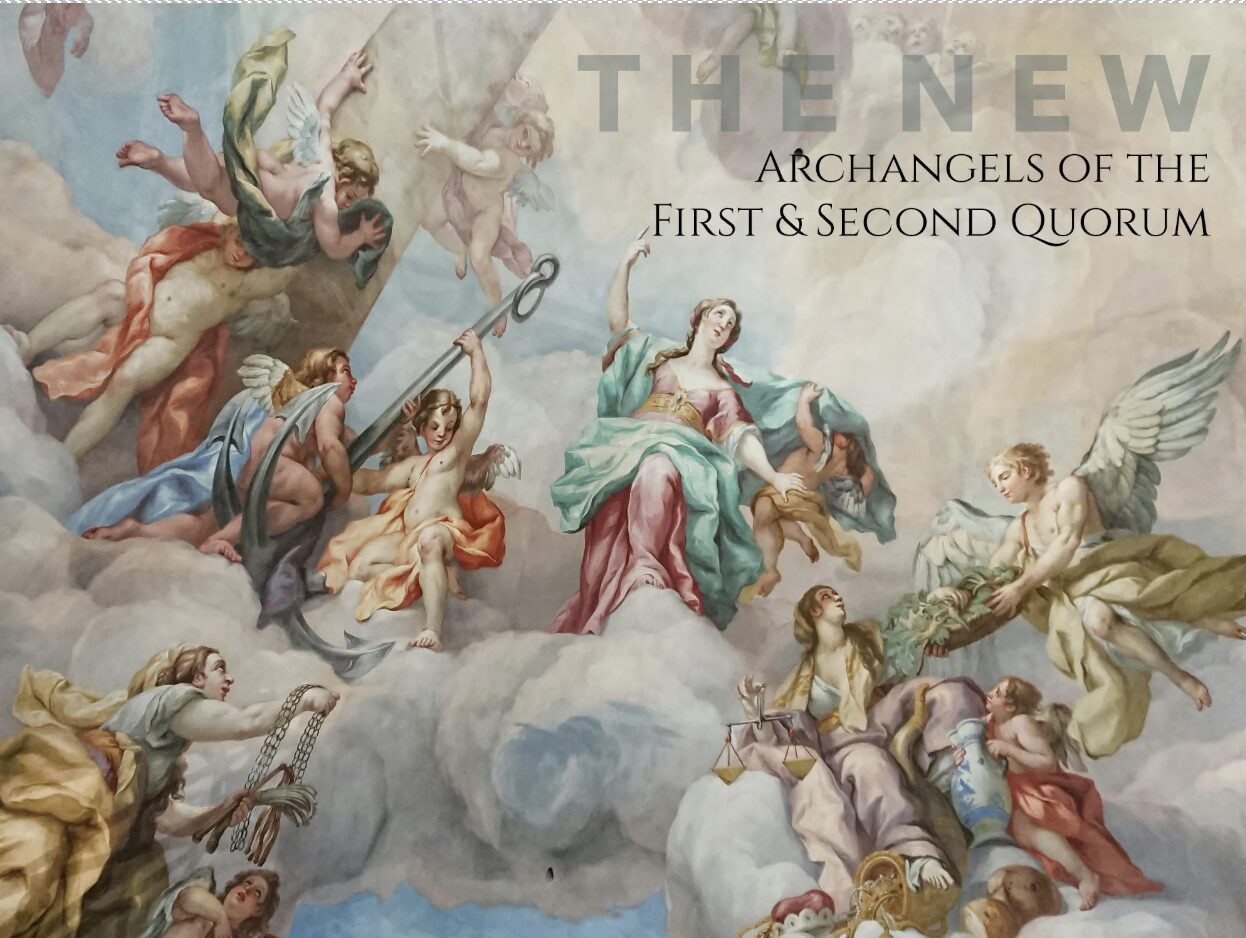
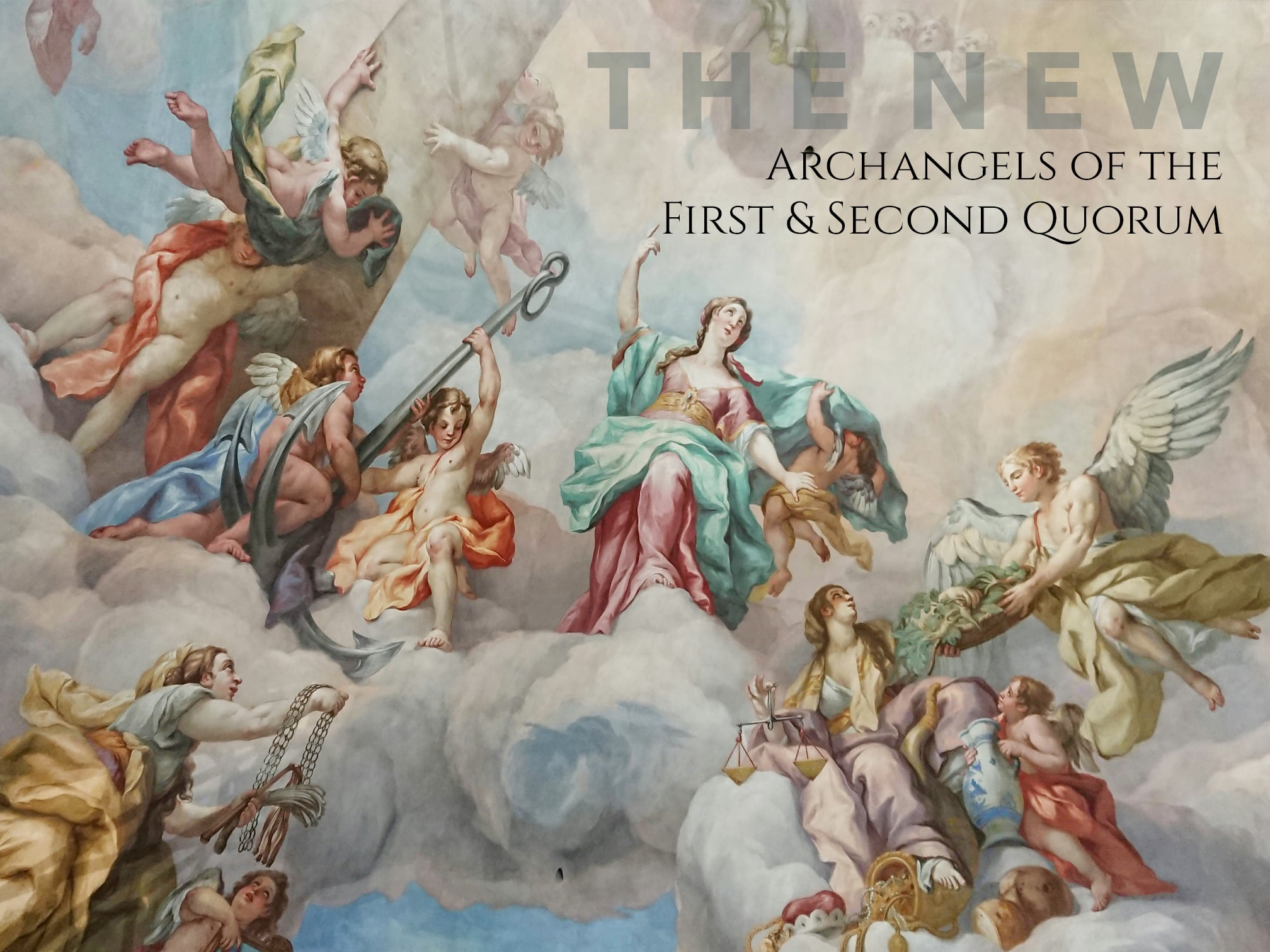
The Archangels hold particular positions within this order. The prefix arch- comes from the Greek arkhi-/archi- (ἀρχι-), meaning chief, principal, first or ruling. An Archangel, therefore, could be understood as a principal force of good.
Within the Mystery School tradition, the Archangels preside over the most important areas of human life – bringing support, upliftment, inspiration, empowerment, healing, clarity, protection and transformation. They represent the very archetypes that can inspire us to transform ‘the dross into gold’ within us.
This idea is also not unique to one culture.
Humanity has been talking about angels for a very long time
Manly P. Hall describes further how across history, civilisations separated by geography, language and religion have described intermediary or celestial beings connecting the human and divine worlds.
Hall observes that the belief in angelic beings existed among numerous ancient peoples and predates Christianity: different cultures developed their own explanations and representations of them.
Hall suggests that angels and archangels are actually fields of light, existing beyond ordinary sensory perception, which may assume or project forms that human consciousness can recognise. Whether this is true or not, Hall goes on to suggest that in Christian art they came to represent the angels’ ability to move between different levels or dimensions. This winged imagery drew upon much older pre-Christian artistic traditions. In Etruscan art, winged supernatural figures appeared, while Roman culture portrayed winged guardian spirits associated with communities and important individuals.
The Essenes were recorded as having their own angelology, teachings considered sufficiently sacred that initiates were sworn not to reveal them.
In the mystical teachings of the Kabbalah, angels are described as spiritual forces or channels carrying information between humanity and God, and lists ten different orders of angels.
Angels feature in Zoroastrian and Persian traditions, while within Islam the Angel Jibril, that is Archangel Gabriel, plays a central role in the story of Muhammad receiving revelation.
Hall suggests that we encounter similar ideas – in different cultures, with different names, different theological explanations with different, yet similar imagery, all pointing to an existence of angelic beings.
What if the visible world represents only a fraction of the life surrounding us?
What if, in the very moments in which we feel forgotten, unsupported or completely alone, there exists an entire unseen order whose purpose is to help?
And what if learning to work consciously with that realm doesn’t require us to escape our human lives at all – but rather enables us to live them with greater courage, clarity and support?
Perhaps the question isn’t whether the angels are there.
Perhaps the question is whether we have learned how to work with them.
And perhaps loneliness may partly arise because modern life has taught us to count only what we can see.
Are you ready to know what these holy beings truely are? |